Select your language
Select your language


The publication of the first six harmonized standards for the Digital Product Passport (DPP) marks a decisive step in the implementation of the Ecodesign for Sustainable Products Regulation (ESPR). These standards establish the technical foundation required to implement a common system for traceability and information exchange throughout the product lifecycle within the European Union.
The European standardization organizations CEN and CENELEC have published the first six standards of the EN 1821x series, developed to support the implementation of the Digital Product Passport foreseen under Regulation (EU) 2024/1781 on Ecodesign for Sustainable Products (ESPR).
The published standards cover the main technical elements of the system:
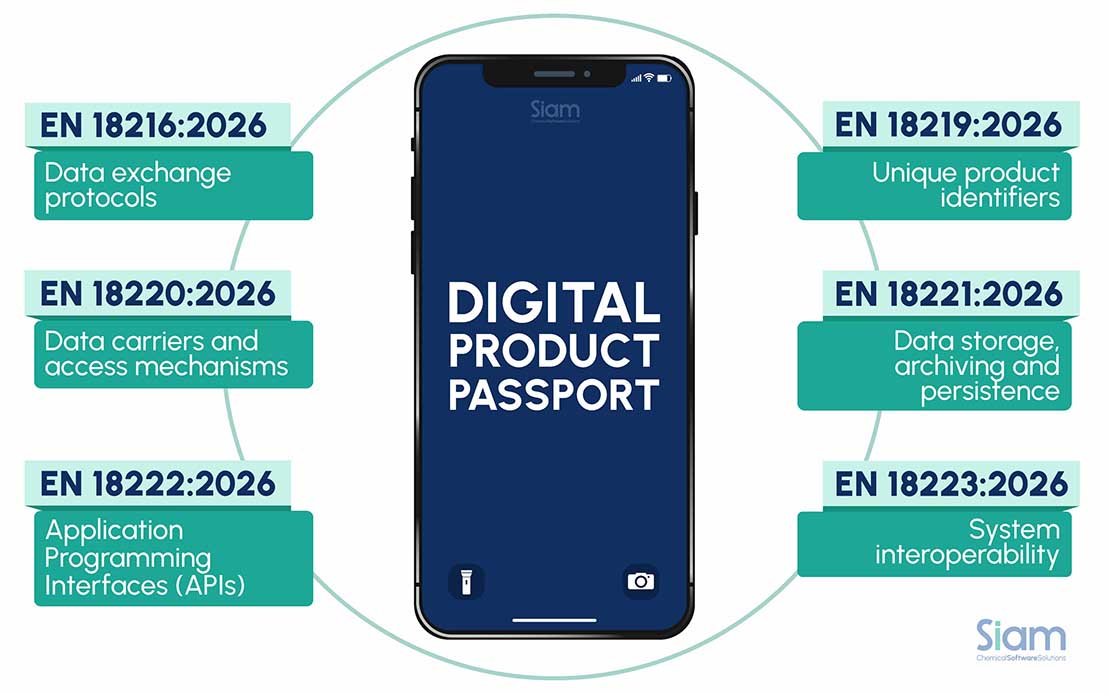
Their objective is to ensure that manufacturers, distributors, technology providers and authorities can exchange information in a harmonized manner, regardless of the sector or platform used.
The standards also define a decentralized architecture for the DPP, whereby information remains under the control of economic operators while a common European registry enables digital product passports to be located and verified through unique identifiers. This approach seeks to ensure interoperability, data availability and data usability throughout the entire value chain.
The European Commission has indicated that these standards will facilitate demonstrating compliance with the requirements of the ESPR Regulation. At the same time, they provide the common technical framework required for the progressive implementation of the Digital Product Passport across the different product groups that will be incorporated into the system in the coming years.
Standardization work will continue with the publication of two additional standards focusing on access rights management, security and information confidentiality (EN 18239), as well as data authenticity, reliability and integrity (EN 18246), which are essential aspects for ensuring trust in the system.
At Siam, we continue to closely monitor the evolution of the Digital Product Passport and the regulatory developments associated with the ESPR Regulation. We are currently working on adapting Chemeter and SdSarea to address future requirements related to information exchange, traceability and data management associated with the implementation of the DPP in the European Union. These improvements will help companies prepare for upcoming regulatory obligations and technical requirements as they are defined for different sectors.